

The Master of Science in Physics at the Adichunchanagiri School of Natural Sciences (ASNS) is a rigorous 2-year (4-semester) postgraduate specialization designed to build strong analytical, mathematical and experimental foundations in modern physics. The program trains students in core pillars — classical and quantum mechanics, electromagnetism, solid state, statistical and nuclear physics — supported by advanced laboratory work.
Delivered under the Choice Based Credit System (CBCS), the curriculum combines Hard Core courses (mandatory discipline specialization), Soft Core electives (chosen from a departmental pool) and Open Electives from other departments, giving students academic flexibility while retaining depth of subject mastery.
Research exposure begins early through lab courses, assignments and seminars, and culminates in a full-semester dissertation / project work in semester IV — often in collaboration with research laboratories, government institutions or industry. Graduates are prepared for PhD admissions, research roles, teaching careers and physics-driven industry and computational positions.
A student earns a minimum of 80 credits across 4 semesters to qualify for the M.Sc. degree. Normal duration is 2 years (full-time); the maximum period allowed to complete the program is 4 years. One theory credit = 16 contact hours; one lab credit = 32 contact hours.
For theory courses: CIE 40% + SEE 60% (100 marks total). For practical courses: CIE 20 + SEE 30 (50 marks). Project work / Viva-voce is evaluated for 180 marks — 60 for the final report and 120 for oral presentation.
Letter grades O, A, B, C, D, E, F are awarded on a 10-point absolute grading scale (10, 9, 8, 7, 6, 5, 0). Passing requires a grade point ≥ 5, minimum 40% in SEE, 50% in CIE, and 45% aggregate. Minimum passing CGPA for degree award is 5.00.
The University follows the UGC conversion formula: P = (CGPA − 0.5) × 10. For example, a CGPA of 8.20 converts to 77%. SGPA and CGPA are computed as credit-weighted averages and displayed on every transcript rounded to two decimals.
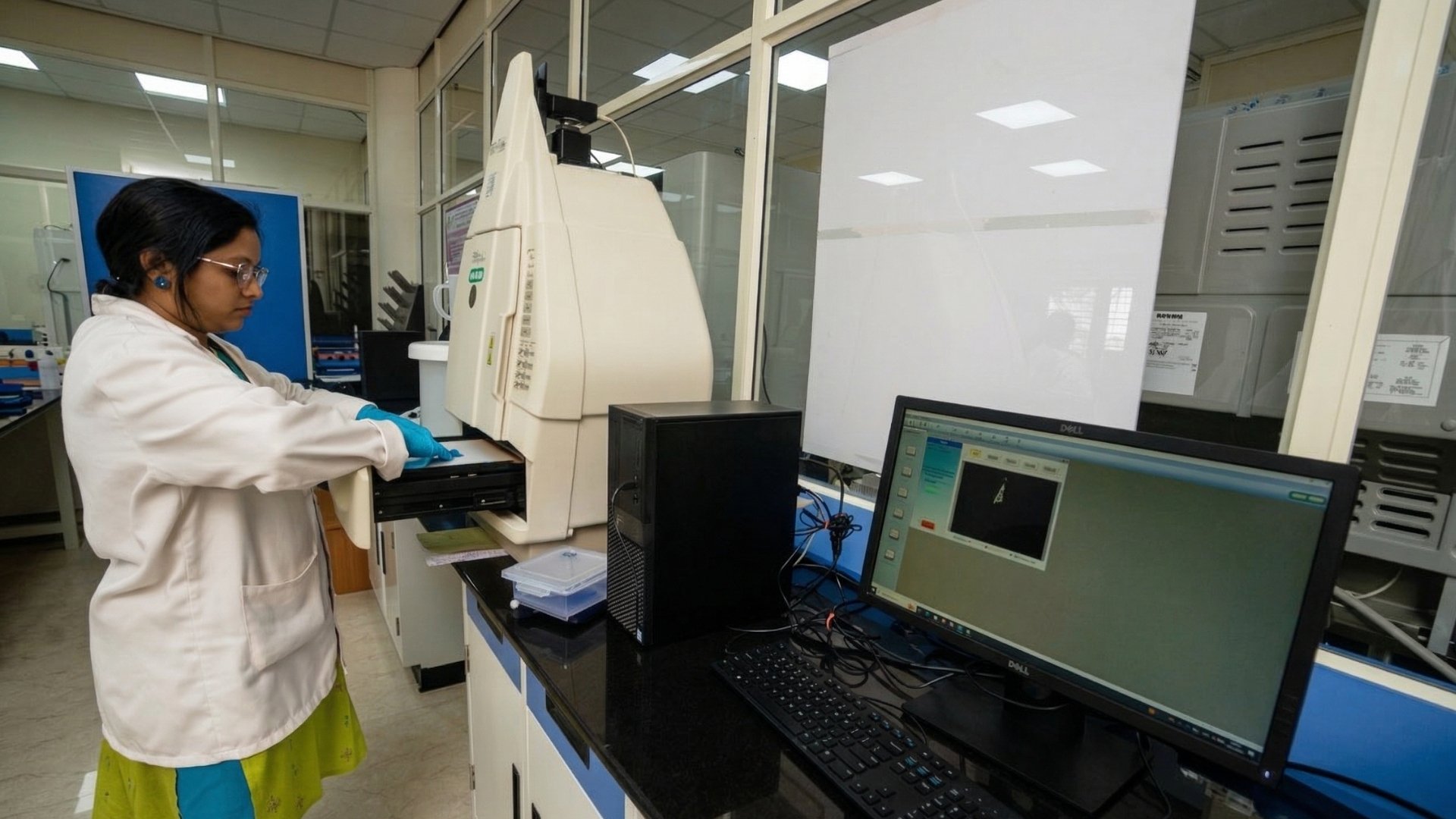
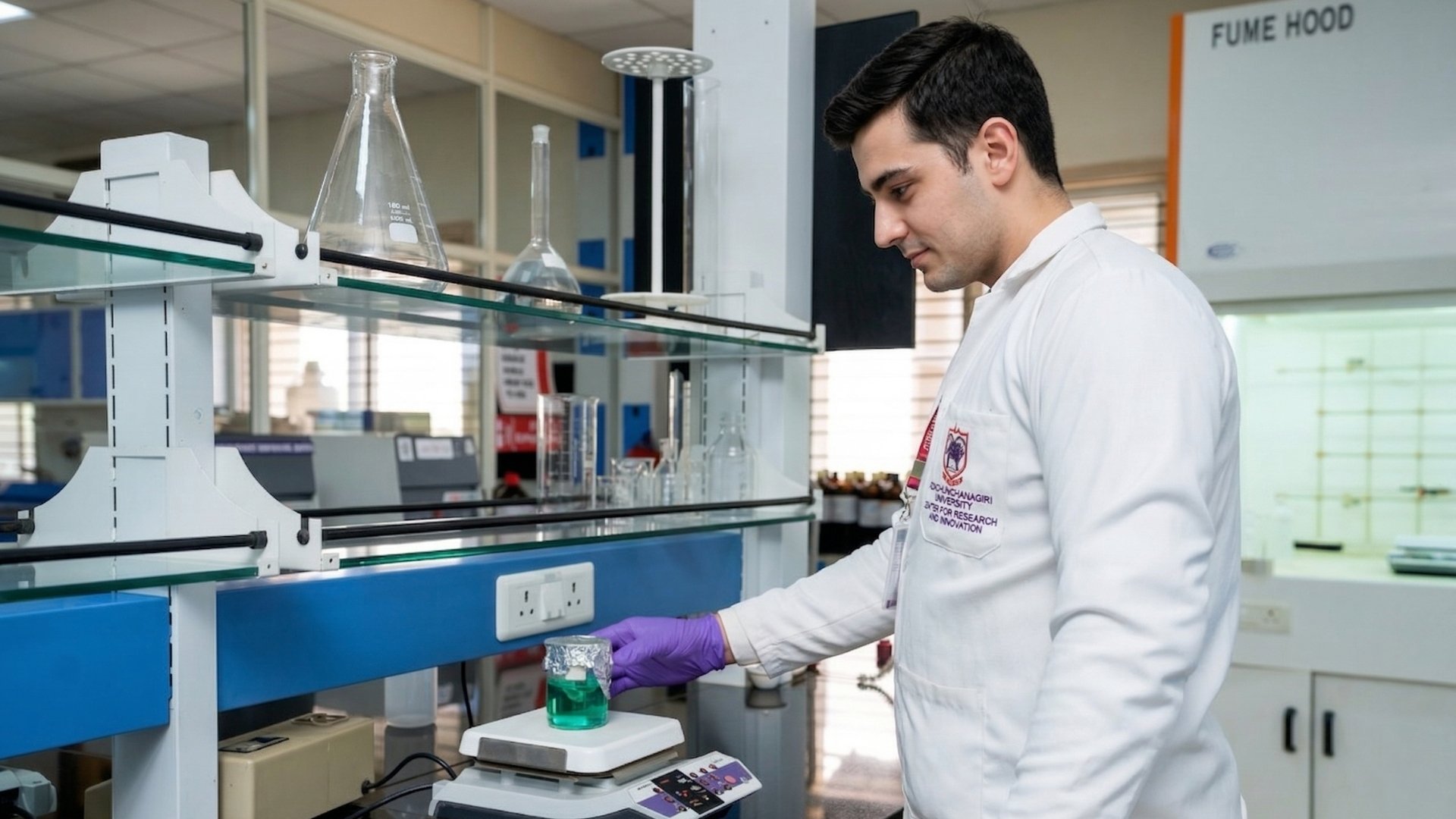
Well-equipped laboratories supporting experimental, solid-state, optics, electronics and computational physics work.
Full-semester individual dissertation culminating in a defended report, enforcing plagiarism check and external evaluation.
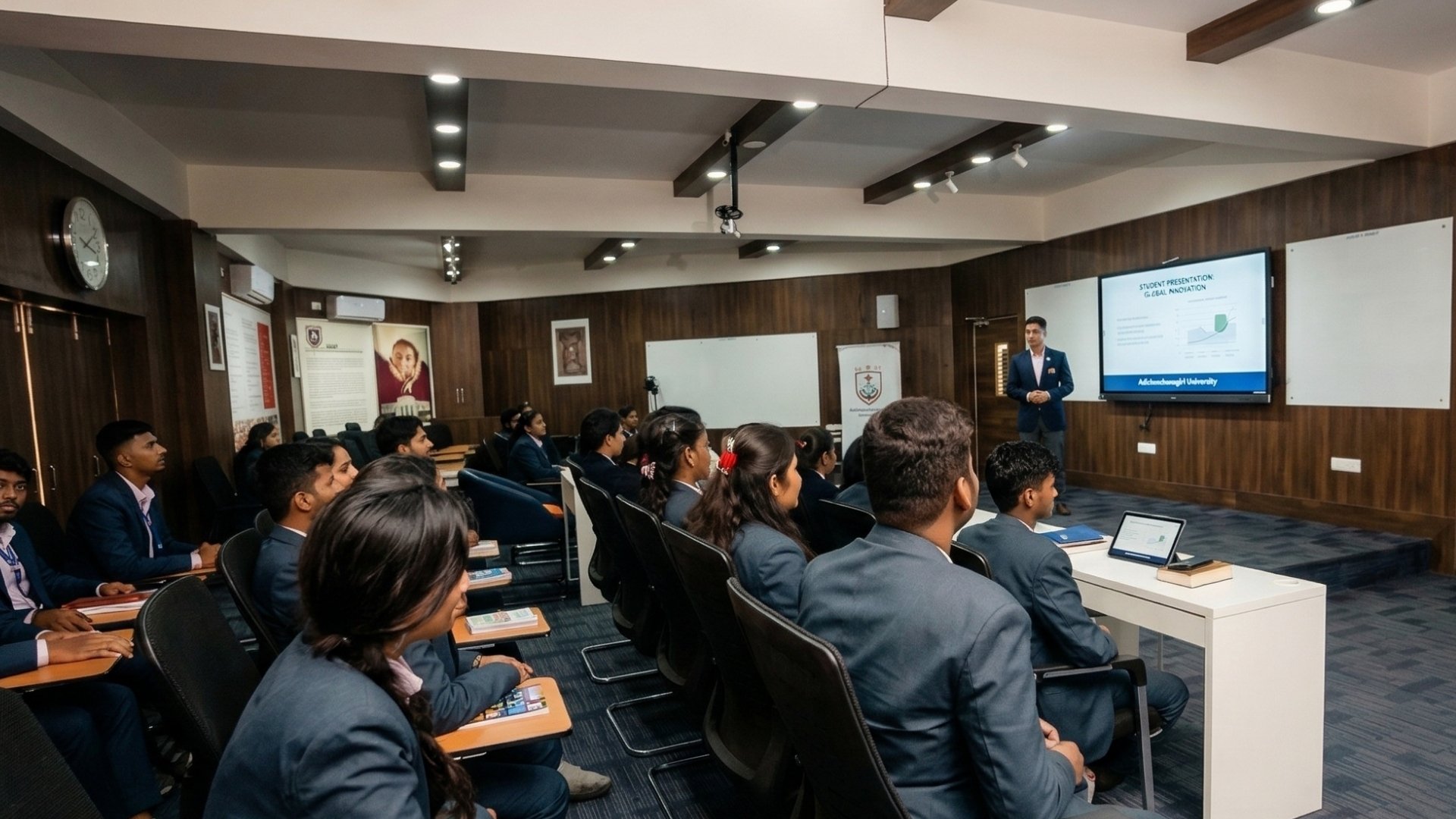
ICT-enabled smart classrooms with audio-visual teaching aids, demonstrations and interactive course delivery.
Each student is guided by an assigned Faculty Advisor for academic planning, research direction and career support.
CBCS structure with Soft Core departmental electives and Open Electives from other departments for personalised breadth.
Project work may be pursued with R&D organisations, national laboratories and industry under joint University guide arrangements.


B.Sc. / B.E. / B.Tech. (or equivalent examination) with a minimum of 40% aggregate marks AND 45% marks in the cognate subject. For the Physics cognate, the candidate must have studied Physics or Mathematics as one of the cognitive subjects in their undergraduate program. SC/ST applicants are entitled to relaxation as per Government of Karnataka norms. Admission is finalised on merit together with PGCET / University entrance qualification as applicable.
Join the M.Sc. Physics programme at the Adichunchanagiri School of Natural Sciences and build the rigorous theoretical and experimental foundation for research, academia and physics-driven industry. Applications are open for the upcoming academic year.