

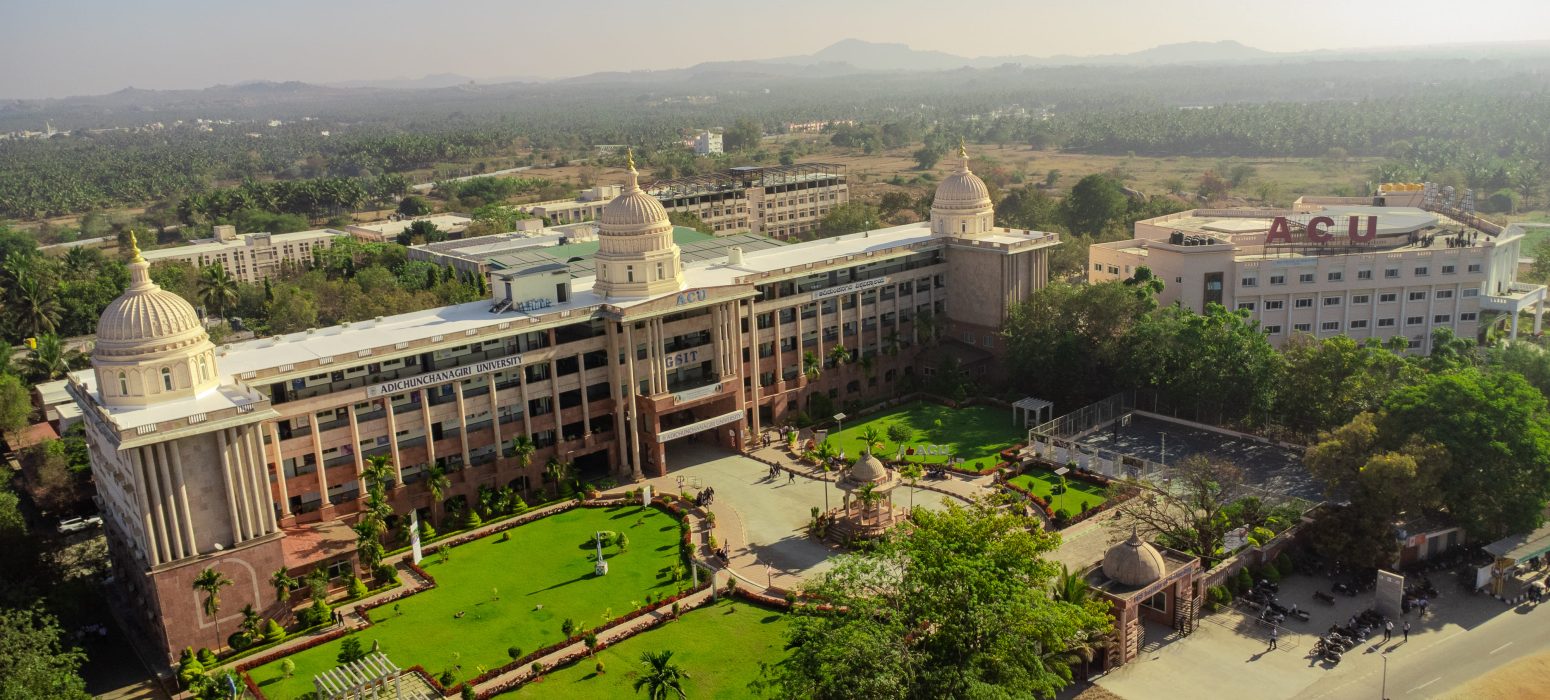
Adichunchanagiri University green campus aerial view
Adichunchanagiri University · 2030 Agenda
Campus GreenInitiatives

Renewable energy, water conservation, wastewater treatment and reuse, waste management, biogas generation and biodiversity — the campus as a living laboratory for sustainability.

₹263.7 L Annual Cost Savings
2,712 MT CO₂ Reduced / Year
17/17 Goals Engaged
Campus as a Living Laboratory
Campus Green Initiatives
♻Solid Waste Management
  • Wet and dry wastes are collected separately in bins with distinct colour coding on campus. The university collaborates with Mangala Waste Resource Management for managing dry waste, averaging 2 tons per month. This partnership is secured under an MoU valid until 2027.
✚Biomedical Waste Management
  • The university has partnered with Prajwal BMW Management System, Hassan, for biomedical waste management under an MoU valid until January 1, 2025. On average, 3,100 kg of biomedical waste is collected per month.
⚙E-Waste Management
  • The university has entered into two MoUs with Sogo Synergy, Bangalore: one from 2020 to 2023 and another from 2023 to 2025. Currently we have an MoU with MKK E-waste Recyclers from April 2025 to March 2026.
♨Liquid Waste Management
  • Sewage Treatment Plant (STP) 2017: an advanced-technology Mixed Bed Bio Reactor (MBBR) wastewater treatment plant with a capacity of 750 KLD (kilolitres per day) was successfully implemented at a cost of ₹3 crore to treat domestic wastewater from ACU.
  • Effluent Treatment Plant (ETP) 2006 of 100 KLD pretreats the effluent of AIMS and AHRC. Present input flow is 20 KLD, and the 17 KLD output is sent to the STP.
♲Reuse of Treated Wastewater
  • Presently the input is 500 KLD and the output is around 450 KLD of treated wastewater. Zero discharge is maintained by effectively reusing the treated effluent for secondary purposes such as gardening and toilet flushing, and the 40–45 kg/month of sludge generated is used as manure.
♨Biogas Plant (2023)
  • A 300 kg capacity Khadi and Village Industries Commission (KVIC) model food-waste biogas plant has been installed on campus. Currently, we process 250 kg of food waste daily, resulting in savings of approximately 10 LPG cylinders per month at the hostel.
☂Rainwater Harvesting
  • Almost 80% of the university buildings have rainwater harvesting systems; the filtered water is collected in 2 sumps of 1 lakh litres capacity each, and 15 recharge pits support groundwater recharge.
☀Solar Initiatives
  • Solar panels: the University partners with TATA Power Solar to install a 600 kW grid solar rooftop system, promoting renewable technologies for on-site power generation. The installed solar panels feature a Monitoring and Management System (MMS) with data-logging capabilities.
  • There are 176 solar water heaters and 300 solar street lights installed across the university campus.
  • Other energy-conservation initiatives: 18,477 LED fixtures, 100 LED street lights, 300 TR of energy-efficient air-conditioning units and 4 heat pumps.
⚘Greenery of the Campus
  • The university’s campus features 4,585 trees of 44 distinct varieties, meticulously maintained by our horticulture department to ensure their health and beauty. Each herb and shrub is uniquely labelled and explained with QR codes for detailed information. The green cover can absorb 108 tonnes of CO₂ per year.
◆ Savings & Impact · External Audit Report
Consolidated Savings of ACU Green Initiatives

The consolidated savings of ACU green initiatives and potential cost savings as per the External Audit report.

Sl. No. Institutional Initiatives Implemented Details Cost Savings (₹ Lakh) Investment Cost (₹ Lakh) CO₂ Emission Reduction (Tonnes)
1Solar Roof Top Photovoltaic System600 kWp50.4270.0497.7
2Biogas Plant300 kg0.68.05.7
3Solar Water Heater176 Nos.61.4132.0606.3
4LED Fixtures18,477 Nos.62.9110.9621.2
5LED Street Light Fixtures100 Nos.1.04.29.9
6Solar LED Street Light300 Nos.2.421.023.2
7Energy Efficient Air Conditioning Units300 TR80.6270.0796.3
8Heat Pumps4 Nos.4.59.044.1
Total263.7825.22,604.4
The various initiatives implemented have resulted in ₹263.7 lakh/year of cost savings and 2,712 MT of CO₂ emission reduction per year, which is a substantial achievement of the university.
We are using cookies to give you the best experience. You can find out more about which cookies we are using or switch them off in privacy settings.
AcceptPrivacy Settings

GDPR

  • GDPR

GDPR