01LEARNEducation for Sustainability
SDG-oriented curriculum, experiential learning, value-added programmes, student projects and awareness activities prepare learners to address real-world sustainability challenges.

17 Goals • One Shared Agenda • Local Action. ACU translates the global 2030 Agenda into action through education, research, innovation, community engagement and sustainable campus practices.
The Sustainable Development Goals (SDGs) are a universal framework adopted by all United Nations Member States in September 2015 as part of the 2030 Agenda for Sustainable Development. Building on the Millennium Development Goals, the SDGs provide a shared roadmap to address the world’s most pressing social, economic and environmental challenges by 2030. The framework comprises 17 interconnected Goals and 169 targets, covering areas including poverty, hunger, health, education, gender equality, water, clean energy, decent work, innovation, sustainable communities, climate action, biodiversity, peace and partnerships.
The SDGs recognise that sustainable development cannot be achieved through isolated actions. They bring together the three dimensions of sustainability — economic prosperity, social inclusion and environmental protection — while emphasising the principle of “Leave No One Behind.” Their interconnected nature calls for collective action involving governments, educational institutions, communities, industry, civil society and individuals.
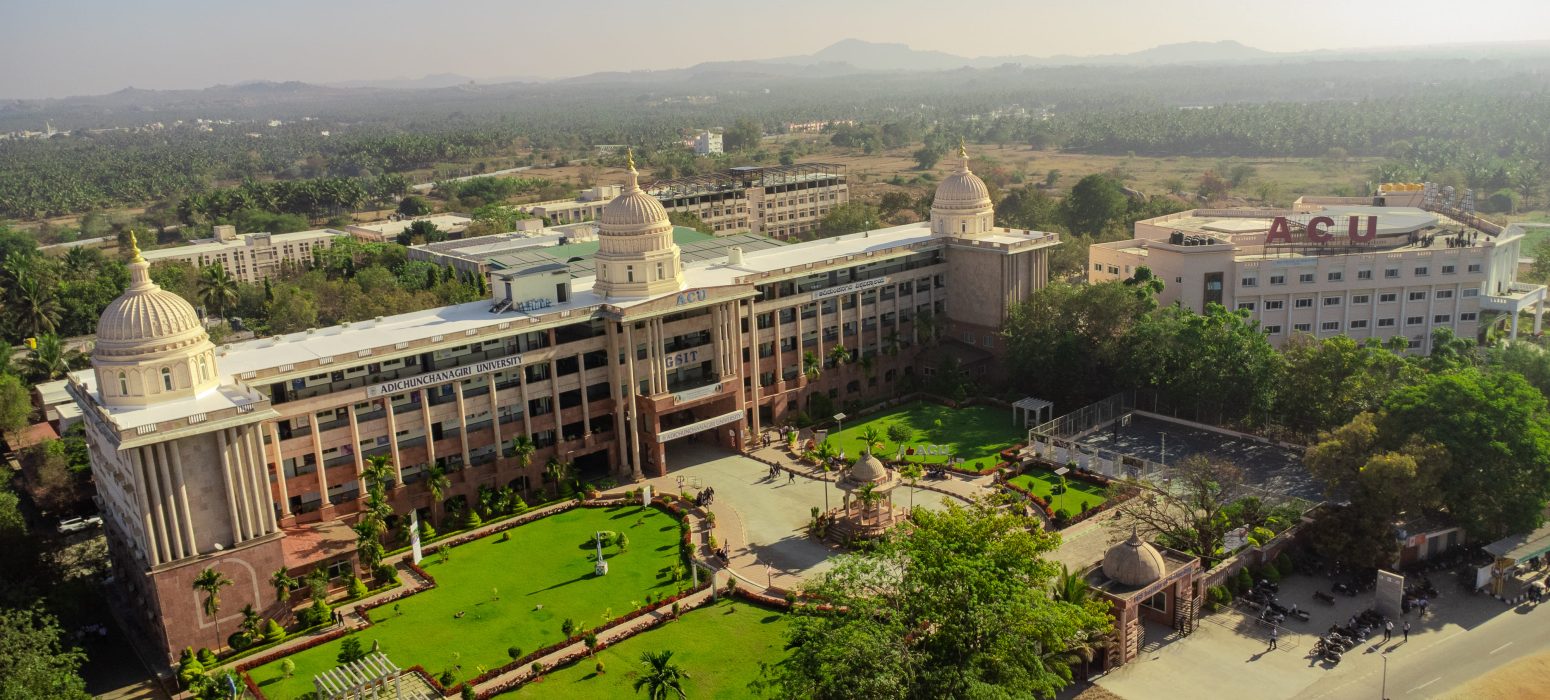
Adichunchanagiri University is committed to translating the global 2030 Agenda into local, measurable and institution-wide action. The University integrates sustainability, social responsibility, inclusivity and environmental stewardship across education, research, innovation, healthcare, community outreach and campus operations. A dedicated SDG Cell, working in collaboration with the Institution’s Innovation Council (IIC), NSS Units, Eco Clubs, SDG Clubs, academic departments and student organisations, facilitates awareness, participation, implementation and documentation of SDG-related activities.
At ACU, the SDGs are viewed not merely as a set of global targets but as a framework for institutional learning, action and continuous improvement. Sustainability-oriented perspectives are incorporated into teaching and learning, while faculty and students engage in SDG-aligned research, innovation, projects, competitions, workshops and experiential activities. Community initiatives extend this engagement beyond the campus through healthcare, rural development, skill development, environmental awareness and social outreach.
The University campus itself serves as a living laboratory for sustainability, where renewable energy, water conservation, wastewater treatment and reuse, waste management, food-waste-to-biogas conversion, biodiversity conservation and energy-efficiency measures demonstrate the practical application of sustainability principles. These institutional practices provide opportunities for students and faculty to observe, learn from and contribute to real-world sustainability solutions.
ACU’s SDG framework brings together five interconnected dimensions:
Integrating sustainability and SDG perspectives into education and student development.
Advancing interdisciplinary research, technology and solutions for societal challenges.
Connecting students, faculty and the community through outreach and social responsibility.
Translating sustainability principles into campus practices and measurable initiatives.
Using assessment, auditing, documentation and recognised sustainability frameworks to strengthen institutional performance.
Adichunchanagiri University translates the global 2030 Agenda into action through an integrated approach connecting education, research, innovation, community engagement and sustainable campus practices. The University’s SDG journey is built around five interconnected pillars:
SDG-oriented curriculum, experiential learning, value-added programmes, student projects and awareness activities prepare learners to address real-world sustainability challenges.
Interdisciplinary research, innovation, technology development and student projects address healthcare, environmental, technological and societal challenges aligned with the SDGs.
SDG Clubs, Eco Clubs, IIC, NSS, healthcare institutions, academic departments and student organisations mobilise students and stakeholders through outreach, awareness, skill development and community initiatives.
Renewable energy, water conservation, wastewater treatment and reuse, waste management, biogas generation, energy efficiency and biodiversity initiatives demonstrate sustainability through everyday campus practices.
Green and environmental audits, sustainability assessments, documentation, external benchmarking and participation in national and international sustainability frameworks support evidence-based action and continuous improvement.
The formal policies that anchor ACU’s sustainability commitments — spanning clean energy and climate, water stewardship, health and well-being, and community partnerships.